
THE VOLCANO OF SANTORINI
Facts and legends
One of the most violent volcanic eruptions the planet has ever seen, which occurred some 3,600 years ago, led to the formation of the island of Santorini and its enormous crater. The eruption occured when the Minoan civilization, in Crete, was at its peak, and scientists claim that it was the reason for its
 collapse. In fact, it seems that ash and volcanic rocks have been found on the island of Crete, which, along with other finds, leads to the conclusion that it was the explosion's gigantic tsunami that travelled for approximately 110 km and literally crashed on the northern part of Crete, destroying everything at its path, bringing thus an end to one of the greatest civilizations of antiquity.
 Others prefer to think that the erruption led to the destruction of the legendary Atlantis, however, no scientific evidence have ever been presented to justify this theory.
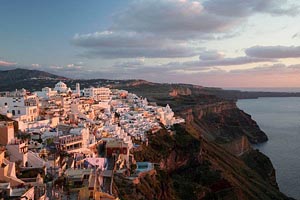
The fact is that this extremely powerful volcanic eruption created one of the most beautiful islands in the whole world and gave us a spectacular and unforgettable view of the Aegean Sea. The island of Santorini, along with Therassia, is what is left from this explosion, after the earth collapsed and the crater filled in with water. The cliffs of Santorini go as high as 300 m and the soil is dark in colour and very fertile. Santorinian products like wine, tomatoes and fava beans are very rich in taste.