
HISTORY OF SANTORINI
In brief
The
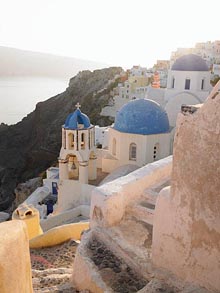 history of Thera (Santorini) is linked to the history of the volcano. Before the volcanic activity, the island was named Strongyli (Circular), due to its shape. But, around 1450 b.C., happened the first eruption of the volcano and changed - not only the future of the island - but the history of the ancient known world. The tidal wave that the eruption caused was of 100 meters high and stroke to the north coast of Crete, causing thus the end of the Minoan Civilisation, destroying everything. The destruction of the Palace of Knossos for instance is well testified.
 The epilog of the destruction was written by the earthquakes and then the volcanic ash, which covered Crete. The result of the seismic activity for Thera was the precipitation and sinking in the sea of a big part of the island, of which was left almost only the part we see nowadays. Afterwards, the land of the island was covered with a thick layer - 30 - 40 m. - of volcanic ash.
The following until the 3rd century b.C volcanic eruptions detached another part, which is Therassia. Around the 2nd - 1st century b.C. begun to emerge the volcanic islets Palaea and Nea Kammeni and in 1956 another earthquake ruined most of the houses of Santorini. But, nothing succeeded to stop life on this island. The name «Santorini» has its origin at the church of Ayia Eirini (Santa Irene in the Venetian age). The name of the capital (Fira) is the corruption of the name of the island - Thera.